Aspire Cockers Uncategorized Custom Jack Screws

Custom Jack Screws

Jack screws.

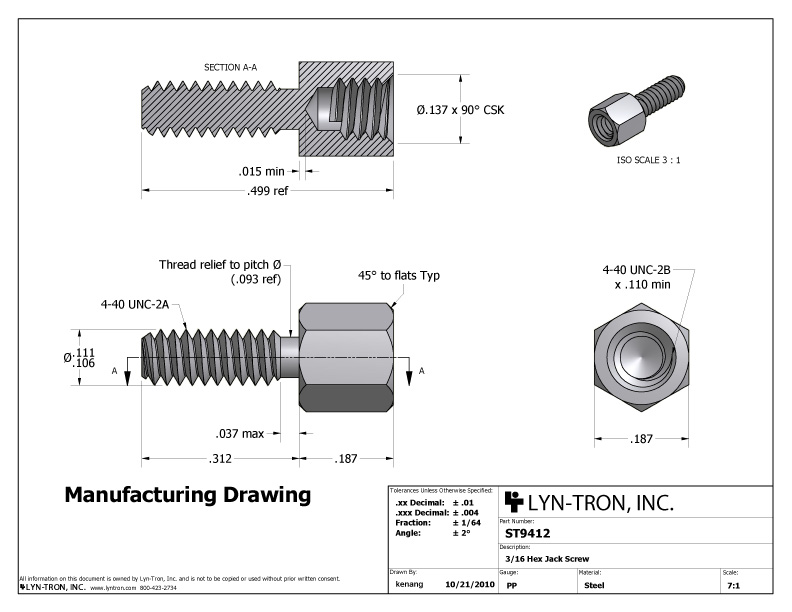
Jack screws are threaded, male-female fasteners that are commonly installed into one half of D Subminiature Style Electrical Connectors and can serve several purposes if used with them. Some products, components, and applications may require custom jack screws to expand their many uses and features. Lyn-Ton can make a jack screw completely customized to your need, from thread length to color. 

Custom Material Selection

Standard screws are manufactured from three materials, each having its own level of magnetic, rust resistance, corrosion resistance, electrical conductivity, strength-to-weight properties, color, and cost. These materials include:

  • Stainless Steel
  • Steel
  • Brass

If your products or application require a different material, we’re able to provide a custom screw to fulfill that need. 

Product Color

Most jack screws come in either gray or yellow, but if the application or product the screw is being used for requires it to blend or the look and aesthetic are a factor, we can manufacture the screw in any color you require. 

Custom Thread Length

All jack screws come with a standard body and female thread, though the male threads can be manufactured to a variety of lengths to fit into many different panel thicknesses. 

If the threads listed on our product page don’t meet the unique needs of your products or application, we are able to manufacture jack screws to your thread length specifications. 

Lyntron | Jack Screws

Order the Jack Screws That You Need

Lyn-Tron Inc offers a wide array of custom sizes and threads for jack screws and is able to incorporate them into any production requested. We encourage customers to read over our selection guide to better understand our current offerings but are able to create custom jack screws as a stand-alone order or within another. 

For over 50 years, Lyn-Tron has been the leading manufacturer of electronic components! We offer a full line of standard electronic hardware, as well as the ability to manufacture custom parts and OEM-designed hardware for your print. If you’re interested in learning more about selecting the right jack screw for your assembly, or if you have any requests for electronic hardware or custom parts manufacturing, visit us by clicking here: Lyntron | Jack Screws

Related Post

What are the Side effects of PRP Treatment?What are the Side effects of PRP Treatment?

What are the adverse effects of Platelet Rich Plasma Treatment?

You might have had heard about Platelet Rich Plasma treatment, but you might not be acquainted with this treatment. It’s basically an extremely concentrated concentration of platelets that is derived from blood that is whole. The platelet concentration is then centrifuged to get rid of red blood cells. The result of this treatment are faster healing for tendon injuries. But it’s not as effective as a vampire facelift. What are the adverse consequences of treatment with platelet rich plasma?

The treatment of platelet rich plasma can be used orthobiologically for musculoskeletal injuries

In clinical practice, platelet-rich plasma (PRP) is a new treatment for most musculoskeletal injuries that uses the patient’s own blood to boost the body’s healing processes. It is an concentrated form of platelets that releases growth factors which aid in the rapid recovery of injured tissues. The procedure requires that the patient be sedated and anesthesia administered to the patient.

The use of platelet-rich plasma (PRP) for musculoskeletal injuries is getting more and more popular. As soft tissue injuries represent nearly half of all injuries to the musculoskeletal body The treatment of chronic and acute musculoskeletal injury may be difficult. Musculoskeletal disorders that are degenerative can interfere with an active lifestyle. Injuries from sports often require long treatment and surgical interventions. In addition, many chronic conditions have unclear results. Despite this, the use for PRP as a part of sports therapy has proven promise in the treatment of chronic articular cartilage injuries.

The American Academy of Orthopedic Surgeons recommends that clinicians thoroughly inform patients about the potential risks, benefits and the regulatory status of plasma that is rich in platelets. This therapy is able to dramatically aid in the healing process of patients suffering from ligament or muscle injuries. And unlike other procedures, platelet-rich plasma is available as an off-label option. Because of this, it has a significant effect on the number of patients seeking treatment for musculoskeletal conditions.

It accelerates the process of healing for tendon injuries

Although the majority of blood is made up of liquid plasma but it also has small solid particles known as platelets. These are the key components of your body’s healing processes. A doctor injects platelet-rich plasma into the injured tissue, which then speeds up the healing process. The increased number of platelets in blood could speed up healing up to five times. The growth factors released by platelets are responsible for repairing the damaged tissues.

Although tendon healing typically takes 18 months, it can still cause scar tissue. PRP can speed up the recovery process through stimulating the growth of blood vessels that are new to the tendon. The treatment also helps reduce scarring and lower the chance of having surgery in the future. The PRP treatment can speed up the process of healing tendon injuries as it can speed up the production of new collagen as well as elastin fibres.

When blood flow to the affected area is reduced or nonexistent the scar tissue can form. The scar tissue may hinder the proper healing process because it hinders the development of blood vessels that are new. Because new blood vessels are required to facilitate healthful healing, they are also blocked. In these instances, the best way to accelerate healing is to increase the number of platelets in the affected area. This procedure is extremely efficient in speeding the healing process of tendon injuries.

It’s not as effective as an avowed facelift.

The Vampire Facelift isn’t the best alternative for complete facial skin resurfacing. In this non-surgical procedure, your blood is drawn and spun through a centrifuge in order to separate the plasma and red cells. This regenerated platelet-rich plasma essentially acts as supportive tissue by the influx of nutrients and building up volume beneath the skin. This process lasts anywhere from 2 to 5 minutes.

The vampire facial On the other hand utilizes the patient’s blood to inject a filler, which is made up of hyaluronic acids. The PRP also helps the skin grow by injecting growth factors into it. The result is more youthful-looking skin. It’s not a surgical procedure, but it’s still effective at treating brown spots, scarring, and wrinkles.

If you’re wondering whether Platelet Rich Plasma treatment is as effective as a vampire facelift, ask your physician about it. This procedure can give you an extra 15% of volume to your face and lasts a few years. While it’s not as effective as a surgical facelift but it’s still a viable alternative if you suffer from a weakened immune system blood platelets, skin cancer.

However, many people believe that it’s. A recent study conducted by the American Academy of Dermatology revealed that many patients who had vampire facials had HIV. The findings suggest that the control of infection isn’t very effective. This is why the New Mexico Department of Health issued a health advisory regarding the procedure. The alert also warns against the use of vampire facials for certain ailments, for instance those taking blood thinners for heart conditions.

Common DUI Defense Strategies: What You Need to KnowCommon DUI Defense Strategies: What You Need to Know

Common DUI Defense Strategies: What You Need to Know

Do you or someone you know face a DUI charge? If so, you are probably wondering what defense strategies might help prove your innocence or save you from a criminal sentence. The truth is, even with a solid defense strategy, a DUI conviction can have long-term consequences if your case isn’t handled properly. But even more daunting than the potential outcomes is not knowing what you should do and what defense strategies may be available to you.

Luckily, there are many possible DUI defense strategies that may help you and be applicable to your case. Part of your attorney’s job is to research and review your options and then select the best strategy for your particular situation. In this blog post, we will take a look at the most common DUI defense strategies that you and your attorney should consider.

Quick Overview

Common defense strategies for DUIs include challenging evidence of intoxication, arguing that an alleged violation of the law was justified, and questioning the legality of field sobriety tests. However, not all defenses are successful, so it is important to work with an experienced 

criminal defense strategy

who can explain the best defense strategy for your specific case.

Challenging DUI Evidence

When it comes to fighting a DUI charge, an experienced defense attorney knows that challenging the evidence is one of many viable strategies. Challenging DUI evidence is critical in order to build a persuasive case and can help defend against circulating misconceptions. The more evidence an attorney can question, the more effective their case will be for their client.

Successfully disputing the DUI evidence begins with the defense attorney critically examining all aspects of the gathering and analysis of the evidence. Was the arresting officer properly trained on field sobriety tests or did they apply them incorrectly? Is there any reason to doubt that the Breathalyzer device was accurately calibrated or operated as intended? Does footage from police body cameras corroborate testimony given by law enforcement agents? These are just some of the questions that may be posed when challenging DUI evidence.

It’s also important to note that while challenging DUI evidence might discredit some or all of it, this should not be equated with claiming it’s invalid altogether since this isn’t necessarily always true. Breathalyzer results, for example, are still reliable and dependable gauges of someone’s sobriety despite mistakes made in their administration or other extenuating circumstances that might have influenced the testing environment. That being said, there are still ways to contest breathalyzer results if warranted within specific regulations in jurisdictions across the U.S., as discussed more fully in the following section about “Contesting Breathalyzer Results”.

Contesting Breathalyzer Results

Contesting breathalyzer results is a commonly used DUI defense strategy. Breathalyzers measure the concentration of alcohol in a person’s blood through their breath, and are highly accurate tools when utilized correctly. However, they may also be prone to error. Seeing as breath tests provide a reliable source of evidence for law enforcement officers, defendants may challenge them in court.

The accused can contest the accuracy of results or call into question the machine’s maintenance and calibration records. In some cases, improper testing or training procedures could result in inaccurate readings. Similarly, factors like radio frequency interference from nearby electronics, certain types of health conditions such as diabetes and GERD, or faulty fuel cell technology within the breathalyzer machine itself can make Breathalyzer test results unreliable.

Contested breath test evidence does not entirely invalidate an officer’s observations of impairment at the scene and during booking. In fact, this type of evidence is often weak and may fail to convince a judge or jury as to its accuracy. This can be particularly true if there is further evidence of guilt supported by either witness testimony or incriminating statements made by the accused while they were being arrested.

Moving on, the next section will examine how blood alcohol levels are measured and what implications this has on DUI defense strategies related to contesting evidence showing high alcohol levels in a driver’s system.

Most Important Points to Remember

It is a common DUI defense strategy to contest breathalyzer results as they may not be 100% accurate. Factors, such as improper testing or training procedures, radio frequency interference, health conditions and faulty breathalyzer technology can make test results unreliable. While contested breath test evidence can weaken an officer’s observations of impairment, it is not always enough to convince a judge or jury that the accused is innocent. The next section will explain how blood alcohol levels are measured and what implications this has on DUI defense strategies related to proving or disproving high alcohol levels in driver’s systems.

Examining Blood Alcohol Levels

Examining Blood Alcohol Levels is a popular defense strategy for DUI cases. Advocates argue that blood alcohol tests do not accurately reflect how impaired someone may be due to the way alcohol is metabolized in the body. As such, their blood alcohol levels at the time of drivers test may not be a reliable indicator of how impaired they were at the time of driving. Furthermore, certain medical conditions can also cause false readings on breathalyzer tests and so any underlying conditions should be considered when looking at the results from a DUI..

On the other hand, proponents argue that these defense strategies are often used to discredit the results based on faulty equipment or procedural errors in administering tests rather than the actual science behind them. The National Highway Traffic Safety Administration (NHSTA) has worked diligently to make sure roadside breathalyzers used by law enforcement technicians are reliable and accurate, leading to stronger cases against drivers accused of DUI. Also, forensic experts such as toxicologists who specialize in analyzing blood samples can provide detailed insight into what a driver’s BAC was at the time of arrest, providing further evidence for establishing guilt of a DUI charge.

Examining blood alcohol levels is just one element of attempting to determine guilt of a DUI charge and it needs to be examined critically and with scientific exactitude if it is used in defense. The next section will discuss searching for faulty evidence, which is another common strategy used by attorneys defending clients in DUI cases.

Searching for Faulty Evidence

When it comes to defending against a DUI charge, searching for faulty evidence is another common strategy. The goal here is to identify if any of the evidence presented against you was faulty or inapplicable to your current legal situation. Such evidence might include blood alcohol testing results, witness testimony, or police reports.

Faulty evidence can be caused by mistakes made along the way, such as the misuse or mishandling of breathalyzers. These tests can be inaccurate and are often subject to human error. Furthermore, faulty evidence might also include witness testimony that is unreliable or assumes something they likely should not be assuming based on their total lack of firsthand knowledge of the incident in question.

The prosecution must show beyond a reasonable doubt that all evidence presented is accuratte and non-faulty. If defense attorneys can identify flaws in how and where the evidence was collected, this strategy could weaken the case and lead to a more favorable outcome for their client.

However, it is important to note that this strategy does not always work out in favor of the defendant. In some cases, even if there were errors made during the process of collecting evidence, it may ultimately not have had an effect on the overall outcome of the case at hand. Relying heavily on this strategy requires careful consideration and a thorough search for potential weaknesses in the presented evidence.

Now that we have established our understanding of searching for faulty evidence as a possible defense strategy for DUI charges, our next section will dive into dismissing DUI charges altogether – a final resort if other strategies prove ineffective.

Dismissing DUI Charges

When it comes to DUI defense strategies, filing a motion to dismiss charges is one of the most common strategies employed. Although this may occur at multiple points in the trial process, typically dismissal requests are originally made prior to trial at an arraignment hearing. Dismissing DUI charges can be an effective way for defendants to secure a more favorable outcome in their case. However, it is important for defendants to understand that the process for achieving dismissal may be difficult and time-consuming.

The primary goal of any dismissal request is to show that there was either a violation of due process or that the evidence used by prosecutors does not meet the legal standards of being beyond a reasonable doubt. Moreover, defendants must demonstrate bias or other constitutional violations on the part of investigating officers orProsecutors. In most cases, courts will grant a motion to dismiss if evidence supporting an arrested charged was obtained illegally or without adhering to proper legal procedures. In these instances, defendants will likely be able to avoid prosecution and secure acquittal or dismissal of charges against them.

On the other hand, it is also important to recognize that successfully arguing for dismissal of DUI charges can be difficult given that prosecutors are required to prove their case with specific evidence gathered under well-defined rules and standards set by both Federal and State statutes. Ultimately, judges have wide discretion in determining whether charges should be dismissed at pre-trial hearings since it is ultimately up to them as arbiters of justice if criminal proceedings shall continue based on presented evidence.

In summary, dismissing DUI charges is possible but is often challenging given the burden that is placed on defendants who must demonstrate violations of due process in order for a motion for dismissal to be granted. The next section will discuss how defense attorneys can file a motion to dismiss as part of their strategy for representing clients accused of DUI related offenses.

  • A 2018 survey of legal professionals found that the top three most commonly used DUI/DWI defense strategies are Alibi, Misidentification of Vehicle & Driver and Diminished Capacity.
  • According to research by the American Bar Association, the most successfully employed DUI/DWI defense strategy is usually an evidence-based defense such as an illegal stop or arrest, insufficient evidence or challenging field sobriety tests.
  • A 2019 study found that approximately 70% of appeals for drunk driving convictions resulted in a reduced sentence or overturning of the original conviction.

Filing a Motion to Dismiss

Filing a Motion to Dismiss is commonly used as a DUI defense strategy. In essence, it means that the defendant files a motion for the court to dismiss the case before it goes to trial. The grounds for such a motion depend on state law and can vary from jurisdiction to jurisdiction. Generally, though, filing such a motion might stem from an infringement of constitutional rights, police misconduct or procedural errors during an arrest.

An argument for filing a motion to dismiss would be the possibility of avoiding a criminal conviction. If necessary evidence is excluded due to police misconduct or if any constitutional rights were violated in determining the results of blood alcohol levels or sobriety tests, filing this motion might be appropriate. If successful, the defendant may not have to face trial or even endure harsh penalties.

The opposing view of this common DUI defense strategy is that there are no guarantees when filing such a motion and courts often accept substantial amounts of evidence illegally obtained. Additionally, without reliable legal counsel or significant knowledge of how motions are filed or argued in court, it could be difficult to determine whether or not this strategy would ultimately succeed.

Despite these possible drawbacks and uncertainty, filing a Motion to Dismiss remains one of several options available to those facing DUI charges. For those hoping to avoid trial and criminal conviction, this defense strategy should not be ignored. In the next section we will outline another common DUI defense strategy: Contesting the Traffic Violation.

Contesting the Traffic Violation

Contesting the Traffic Violation is one of the common DUI defense strategies. Typically, drivers are pulled over for demonstrating suspicious behaviors, such as making wide turns or drifting across lanes. When a motorist has been charged with a DUI, it may be possible to contest the traffic violation that initiated the stop in the first place. Those who successfully challenge their initial stop can cast doubt on their eventual arrest for driving under the influence.

Though challenging a traffic violation may seem like a straightforward proposition, it can be difficult to prove that an officer made a mistake in issuing the citation for a particular violation. Were there witnesses able to support your claim? Has traffic camera footage been preserved? Are there other circumstances that could have contributed to your original infraction? The success of this strategy will depend largely on an individual’s ability to assemble compelling evidence in defense of their case.

On the other hand, prosecutors must also provide evidence that a defendant did, in fact, commit the alleged traffic violation at issue in order to secure a conviction. If they are unable to present concrete evidence that supports their claim – i.e., testimony or dash cam footage – then the defendant may stand a better chance of having their charge dismissed altogether.

Therefore, determining whether or not to contest an initial traffic violation can be a difficult decision. Those considering this option should obtain assistance from an experienced criminal defense strategy who can help evaluate their case and craft an effective defense strategy accordingly.

After determining how best to contest the traffic violation – if at all – it’s important to assess whether or not the arresting officer followed proper protocol during the course of events leading up to your arrest. This will be discussed further in our next section about Investigating the Officer’s Behavior.

Investigating the Officer’s Behavior

When mounting a defense against driving under the influence (DUI) charges, it is important to review whether or not the officer who stopped and/or arrested the accused followed all proper protocols. If any rights are violated during the stop or arrest of a suspected intoxicated driver, then it could potentially lead to dismissal of the DUI charge. It is important to investigate whether an officer acted improperly in order to build a strong defense strategy.

If the defense is able to prove that the arresting officer was acting on out of unlawful bias or without probable cause, then evidence obtained after the stop may be excluded from being used as evidence in court—including results from field sobriety tests and results from a breathalyzer test. Even if an officer proceeds with caution throughout the process, false assumptions or unlawful searches can still lead to constitutional abuses and should be taken into consideration when building a legal defense strategy.

On the other hand, it may also be difficult for defense lawyers to uncover inconsistencies and wrongful behavior by officers during the traffic stop, given their training and expertise. Officers need only a slight suspicion that a person is operating under the influence of alcohol in order to move forward with conducting field sobriety tests, chemical tests, and requesting information such as driver’s license and vehicle registration. While there have been instances where officers have acted incorrectly while conducting a DUI investigation, prosecutors will likely point to training procedures as proof that officers reacted correctly in most cases, making it difficult for warrantless searches to hold up in court.

Regardless of where one stands on this issue, determining whether or not an officer’s behavior was appropriate is an important step towards mounting a successful legal defense strategy against DUI charges. Investigating the officer’s behavior will help determine if any evidence gathered within the chain of events can be challenged in court and serve as grounds for dismissal due to constitutional abuse. The next section will present how dismissal due to constitutional rights violations might occur when mounting an effective legal defense against DUI charges.

Dismissal by Constitutional Rights Violations

When a person’s constitutional rights are violated by law enforcement during the arrest process, they may be able to have their DUI charges dropped or dismissed. One of the key elements of understanding if a constitutional rights violation occurred is knowing how these constitutional rights apply during a DUI arrest. The two primary constitutional rights violations that often come into play during a DUI case are an illegal search and seizure and the failure to read Miranda rights upon arrest.

Illegal Search and Seizure: When it comes to DUI cases, the Fourth Amendment protects people against illegal search and seizure, meaning law enforcement needs probable cause such as proof of drunk driving before they can legally search the vehicle or person of the suspect. If they do not have probable cause, they must obtain a judge-issued warrant before searching the vehicle or the suspect can choose to deny the search anyhow. If law enforcement proceeds with a search without following these procedures, then it is likely in violation of the Fourth Amendment and would be considered an illegal search and seizure – meaning any evidence gathered could be dismissed in court.

Miranda Rights: Another common Constitutional right related to DUI cases is the right to remain silent as given by Miranda rights. In order for an individual’s answers to police questions about drunk driving behaviors (e.g., admitting to having drinks before operating a vehicle) to be admissible in court, police must read them the Miranda warning when making an arrest and gaining other information from a suspect outside of public spaces. If law enforcement does not provide this warning, then any information provided by the defendant can also be excluded from court evidence and dismissal/acquittal of charges may result.

While people accused of DUI may attempt to use dismissals based on Constitutional rights violations as defense strategies, prosecutors can dispute that these violations actually occurred or leverage other forms of available evidence against a defendant even after applicable evidence has been excluded from defendants’ cases due to Constitutional violations at arrest time. Ultimately, determining whether Constitutional rights were violated during an individual’s arrest is fundamentally up to the courts, which makes understanding this legal process important for anyone using this type of defense strategy against DUI charges.

Now that we understand dismissal by Constitutional right violation lets turn our focus towards developing an effective defense strategy for those facing DUI charges.

Developing an Effective Defense Strategy

There are a variety of ways to develop an effective defense strategy for those charged with driving under the influence (DUI). First and foremost, attorneys will advise their clients to refrain from talking about the case or providing any additional information not requested by the authorities. An individual should also remember that the burden of proof lies with the prosecution; meaning that the defendant does not need to prove innocence but rather the prosecution must establish guilt beyond a reasonable doubt.

In building a defense, it is important to understand that there are wrongful arrests and other contributing factors which may lend themselves as mitigating circumstances. These can include medical conditions leading to false readings; law enforcement officers failing to follow protocol; faulty breathalyzer tests; and questioning without proper legal representation. It is also possible that civil rights were violated such as an unwarranted search or seizure.

A valid defense could hinge on errors in field sobriety tests. Research has shown that these tests have a high margin of error, especially if they are conducted at night, if there is inclement weather, or if road surfaces do not provide suitable footing. Contested evidence, witness testimony, and/or expert testimony can sometimes reveal irregularities in the testing procedures or failures on behalf of the officer to carry out protocol correctly.

Most states require a motorist to submit to chemical testing when pulled over for suspicion of DUI offenses. A refusal can result in immediate suspension of one’s driver’s license and additional penalties, so this should be taken into consideration for developing a successful defense strategy.

Developing an effective defense strategy is no easy task and requires much thought and deliberation. By taking into account all available evidence and weighing it with respect to factual accuracy as well as legal precedent, defendants facing DUI charges can increase their chances for favorable results. As such, it is highly recommended that anyone accused of DUI seek qualified counsel in order to learn which specific strategies may be viable defenses in their own circumstances.

Conclusion:

With careful consideration of the facts at hand and experienced legal guidance, defendants facing DUI charges can bolster their chances for favorable outcomes through effective defensive strategies. In the next section, let’s examine common judicial proceedings related to DUI cases as well as potential outcomes in greater detail.

Conclusion

In conclusion, the options for defending DUI cases are myriad and varied; it’s important for anyone charged with a DUI to consult with a qualified attorney who is trained in defense strategies to best navigate any particular case. While some of the defenses may seem obvious, such as challenging a breath test, others require experienced insight into the court system, including questions of procedure or legal precedent. No matter what an individual’s circumstances are, an experienced DUI legal help will be able to help them explore all their options when facing these charges and ensure that their rights are protected throughout the entire process.

A vigorous prosecution of all DUI cases ensures that public safety remains paramount and must be balanced with protecting individuals from unjust convictions or punishments. All citizens, no matter what crime they are charged with, have the right to a fair trial and the right to defend themselves against false accusations or faulty judgement. By understanding common defense strategies employed against DUI charges, individuals can make sure that their rights are respected and protected as they go through the arduous legal process.

Responses to Common Questions with Detailed Explanations

What legal evidence and defenses can a person use in a DUI case?

A person facing a DUI charge may use a number of legal defenses and evidence in their defense. The most common defense strategies are:

1. The invalidity of the initial traffic stop – if the officer did not have reasonable suspicion to make the traffic stop, any evidence gathered as a result may be ruled inadmissible;

2. Challenging the field sobriety tests – evidence from such tests can be disputed based on a number of external factors such as the road conditions and weather;

3. Questioning the device used to collect breath samples – there is potential for calibration issues or malfunctioning of such devices that can be questioned in court;

4. Evidence of inexperience or medical condition – those with limited driving experience or physical conditions that put them at risk for failing sobriety tests could argue medical merits to help their case;

5. Evidence of mental state during arrest – feelings of fear and confusion during an arrest may indicate involuntary statements or false submission to requests made by officers.

All arguments should be supported with evidence from reliable sources and witnesses as it will allow a person building their defense to build a stronger case.

What are some tips for finding the right DUI defense attorney?

When looking for the right DUI defense attorney, it’s important to do your research. Here are a few tips for finding the right attorney that can best handle your case:

1. Do your homework: Research the attorney’s qualifications and experience in defending DUI cases. This is especially important if you plan to take your case to court. Read online reviews and check references if possible. Make sure they are familiar with the local court system or have experience in other complex cases like yours.

2. Consult an expert: Seek out an attorney who specializes in DUI defense or criminal law. They will be able to provide more up-to-date advice on your options and may be better equipped to represent you based on their knowledge of the legal system.

3. Consider costs: Determine a budget for the attorney’s services and compare prices before making a final decision. Look into payment plans and other flexible options that can make hiring an attorney more realistic for you.

4. Check references: Ask previous clients of attorneys you’re considering how they were treated, if they felt they got a fair result, or what experience they would share with others looking for an attorney to represent them.

5. Communicate clearly: An experienced DUI defense attorney should answer any questions you have and provide clear guidance on what steps to take next. Maintain open communication throughout the process and ask for updates as needed so you can make informed decisions for your case.

What are the common arguments used in a DUI case?

In a DUI case, the most common arguments used by defendants are centered around challenging the validity of the drunk driving stop, questioning the accuracy of the field sobriety test or breath/blood sample tests, and demonstrating that the defendant’s intoxication was not actually impaired.

1. Challenging the Validity of the Drunk Driving Stop: In this argument, the defendant claims that their Fourth Amendment rights protecting them from unreasonable searches and seizures were violated. If police did not have reasonable suspicion that a person was committing an offense, such as erratic driving or a smell of alcohol in their vehicle, then it is possible for any evidence collected during a DUI stop to be excluded from court proceedings.

2. Questioning Field Sobriety Test Accuracy: Most DWI/DUI arrests rely on field sobriety tests (FST) such as walking in a straight line and counting down numbers. Questioning the accuracy of these tests can prove beneficial in reducing possible conviction or charges. This strategy would require hiring an attorney with experience in successfully challenging FST results using science and data to show why they may not be reliable indicators of intoxication level.

3. Demonstrating Intoxication Was Not Impaired: It may also be argued that while intoxicated at the time of driving, that according to law enforcement officials and available evidence, there were no signs of actual impairment or unsafe driving behavior while behind the wheel. To bolster this argument, factors such as where and when the traffic stop occurred may prove helpful in showing that intoxication levels exceeded legal limits but did not create an unsafe driving situation.

The Risks and Side Effects of Ketamine TherapyThe Risks and Side Effects of Ketamine Therapy

Though ketamine is a legal prescription drug, it is becoming more popular as a recreational drug. It is especially popular among club-goers who seek a short-term escape from the stresses of life. Many people are surprised to learn that ketamine is also a powerful mood enhancer. Here are some side effects and risks associated with ketamine. These are the most common side effects associated with ketamine.

The ketamine treatment is quick and easy. It is performed under the supervision of a doctor. After treatment, the patient must remain in the clinic at least 2 hours. This observation period is necessary for safety reasons. It can be used to relax or read. Patients can do whatever they like during this time, but it’s important to tailor activities to their mood and energy levels. Most ketamine providers require a face to-face consultation with a physician. Mindbloom, however, has remote screenings and turns away about 35 percent of applicants.

Patients with underlying conditions should consult with their doctors before receiving ketamine. Ketamine is not safe to be administered to children and adolescents. The drugs have also been shown to cause a high blood pressure and are contraindicated during obstetrics or pregnancy. During the maintenance phase, a patient must be monitored by a healthcare provider to make sure they are able to cope with the effects of ketamine.

In addition to its psychedelic effects, ketamine is not recommended for use in patients with underlying medical conditions. Because it passes through the breast milk, ketamine is not recommended for use during pregnancy or obstetrics. Ketamine can also be absorbed into breast milk if you’re pregnant or breastfeeding. Ketamine can be fatal in some cases. While it is generally not a suitable treatment for those with underlying conditions, it can be a valuable option for patients who’ve not been able to find lasting relief through conventional treatment options.

As with other medications, ketamine can cause serious health problems. A patient may experience vivid visual hallucinations depending on the dosage and treatment duration. Ketamine can also cause a coma which can be dangerous. The patient may experience memory loss or a loss of concentration during the ketamine maintenance period. Although ketamine is generally safe, it can lead to other harmful side effects.

While ketamine is not a drug that can be used for depression, it does have some serious side effects. As with all psychotropic drugs, ketamine is not FDA-approved for this purpose, so the treatment is not covered by health insurance. But if you are willing to spend the money, ketamine therapy may be an excellent alternative. You’ll be happy you did ketamine therapy for your depression symptoms.